
Kinney County VINE Coverage
The Kinney County Sheriff’s official page directs the public to VINELink for custody status. That is the strongest local basis for using VINE with a county-jail inquiry. VINE receives events from participating agencies. It is not the Sheriff’s original booking-out ledger, and no fixed Kinney field or participation list was found.
Texas state-prison notification is separate. TDCJ replaced its VINE system with IVSS in 2019. County VINELink serves participating local feeds. IVSS serves TDCJ custody, parole, and mandatory supervision. Federal prison uses the BOP locator, and immigration custody uses ICE ODLS. One search does not cover all four systems.
Search One Kinney VINE Record
Search one person and reject weak matches. A common name alone is not enough. Compare age or birth data, source agency, location, and any booking or offender ID offered by the live interface.
- Open VINELink, select Texas, and choose offender search.
- Enter the exact name or an offered booking identifier.
- Compare descriptors and the reporting agency.
- Read status, source, location, and event date together.
- If unclear, call the Sheriff or KCDC and check the court record.
The broader Kinney County release search helps classify the custodian first.
Kinney VINE Release Fields
A retained record may report released or out of custody and an event date. Treat that as an event supplied by the named source. It does not show acquittal, explain a transfer, or rule out a later hold.
| Field | Meaning |
|---|---|
| Custody status | The reporting source’s label |
| Facility or source | The agency supplying the event |
| Event date | When the change was recorded |
| Identifier | A key for separating same-name records |
| Notification events | Choices offered for that record |
Feed lag, purge rules, spelling, and transfer can cause a missing result. Request the booking-out sheet for documentary proof.
Register Kinney Release Alerts
Registration begins from the correctly matched record. Event names and delivery choices can change, so follow the live interface.
- Select registration on the matched record.
- Choose an offered event, such as release or transfer.
- Select an available phone, text, email, or app channel.
- Enter and confirm the destination.
- For telephone alerts, use the PIN when required. It confirms receipt and can stop repeat calls.
Keep contact details current. An alert is a prompt to verify with the holding agency.
Confirm Kinney VINE Releases
Call the Kinney Sheriff at 830-563-2788 for the county holding facility or KCDC at 830-563-6222 when that building is involved. Ask whether the person is physically present and whether the last event was community release or transfer. Then obtain the court docket or written release record.
For TDCJ, the public inmate search is current-custody only. Use TDCJ’s former-inmate email service, Parole Division, and IVSS after release. Use the BOP locator for federal prison and ICE ODLS for immigration custody.
Kinney VINE and IVSS Split
Texas changed its state-prison notification layer in 2019. The TDCJ transition notice says IVSS replaced TDCJ VINE and the older notification system. This matters in Kinney because a local arrest, a TDCJ commitment, and KCDC federal custody belong to separate sources.
Use IVSS for a person in TDCJ custody or on parole or mandatory supervision. IVSS is account-based, not a legacy VINE PIN system. TDCJ says registration is confidential and free. Help is available at 800-848-4284 or victim.svc@tdcj.texas.gov.
The IVSS portal shown below is the Texas state-prison layer.
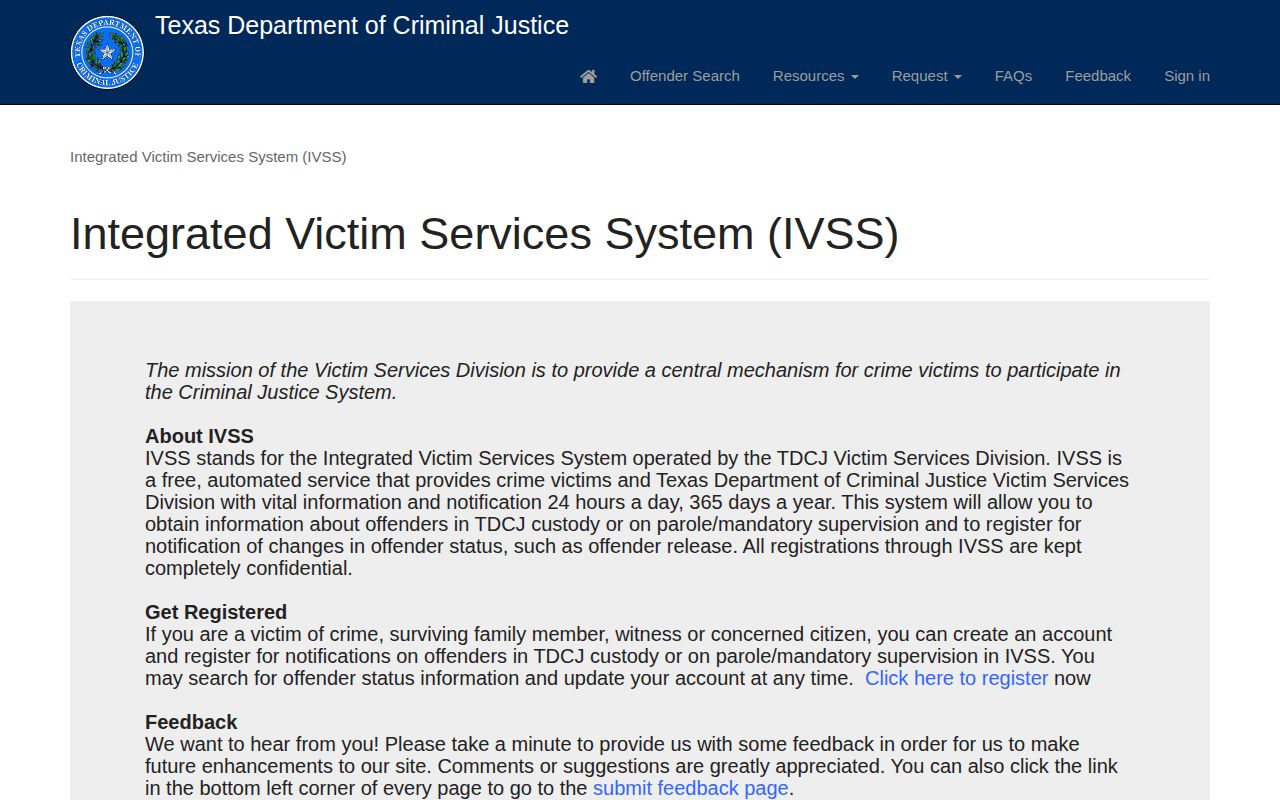
The image distinguishes IVSS from county VINELink; it does not show a private person’s result.
Match Kinney VINE Identities
Identity review protects against a false match. Start with a full name, then compare the date or year of birth, agency, booking number, and event range. If VINE offers an offender ID, use it in later calls. A photograph can support identification, but it does not prove conviction, current status, or release.
Two people can share a name. A spelling difference can also hide the right entry. Search reasonable name forms, but never combine fields from separate results. When a record seems likely, call the source agency and repeat the identifier shown. Ask staff to distinguish physical custody, community release, and transfer.
Kinney County has more than one custody stream. The Sheriff facility handles local arrests and short county matters. KCDC can hold federal defendants, people awaiting BOP placement, or immigration cases under agency agreements. TDCJ custody occurs at state facilities outside the county. Each stream requires its own identity check.
Read Kinney Release Status Carefully
“Out of custody” describes the reporting source’s status at that point. It does not answer why custody ended. Bond, time served, dismissal, court order, transfer, parole, and discharge are distinct. The court docket explains legal posture, while the booking-out sheet records the local physical event.
If staff report transfer, obtain the receiving agency. Continue with TDCJ for a state commitment, PACER or USMS for a federal pretrial case, BOP for a designated federal prisoner, or ICE ODLS for immigration custody. Do not stop merely because the Kinney entry disappeared.
A delayed event is also possible. VINE depends on an agency feed, and the Sheriff does not publish a cadence for Kinney events. An urgent pickup or safety decision should be based on a direct agency confirmation. Later, request the retained release record for a stable written source.
Kinney Records After VINE
VINE is strongest as a status and alert service, not as a permanent archive. A released record can age out, the name may no longer return, or the source may change its displayed fields. Texas retention rules create a better historical route for county records.
The county jail register includes the release or transfer date and is retained permanently under the state schedule. Booking-in and booking-out records and release or transfer orders have a minimum period of release or transfer plus two years. An expunction order or another law can alter access, and retention does not guarantee web display.
Email a focused public information request to publicinformation@co.kinney.tx.us. Identify the person, approximate custody dates, and booking number if known. Ask for the booking-out or release sheet rather than every file. Pair that record with the relevant Kinney court docket to learn whether the event involved bond, sentence completion, dismissal, or another order.
Kinney TDCJ Notification Fields
A current TDCJ result may show the facility, identifiers, conviction county, sentence data, projected release date, and parole eligibility date. Those fields are useful before release, but the public search expressly covers people currently incarcerated in TDCJ. A former prisoner may disappear from that interface.
For former custody, email pia@tdcj.texas.gov with the full name and seven-digit TDCJ number. If the number is unknown, provide exact birth information or approximate age and conviction county. Put the person’s name in the subject. TDCJ describes this as a no-fee incarceration-history service.
IVSS continues the notification role for TDCJ custody and post-release parole or mandatory supervision. A parolee is released from confinement but not discharged from the sentence. Keep “released,” “paroled,” and “discharged” separate when describing an alert.
Note: Check the live interface because notification methods, event labels, and source participation can change.
Kinney Federal Release Checks
VINELink is not the search for a federal prisoner. KCDC can house federal defendants under a USMS agreement, and that physical location does not turn the case into a county matter. A pretrial defendant may never appear in the BOP locator because USMS retains responsibility before designation.
Use the federal docket and USMS prisoner route for pretrial custody. If a sentenced person enters BOP, search the BOP locator by register number or name. A former federal result may show a release date, while “not in BOP custody” alone does not explain where the person went. ICE custody must be searched separately because immigration detention may follow criminal custody.
Ask KCDC whether the person is physically present and which agency owns the custody. If the answer is transfer, record the receiving agency and continue there. Do not interpret departure from KCDC as a Kinney County community release.
Manage Kinney Release Alerts
A registration remains useful only if the contact channel works. Confirm the phone number or email at entry, follow the service’s verification step, and update it when contact information changes. Keep the PIN private when the telephone workflow uses one.
One alert can describe one source event. A transfer notice may require a new search and a new registration with the receiving system. If the person moves from local custody to TDCJ, switch to IVSS. If the person moves into federal or immigration custody, use the relevant federal source.
Automated notice can be delayed. For a time-sensitive concern, call the holding agency and state the identifier. Then preserve the date, time, agency, and answer. That short log helps reconcile a later VINE event with the written release or transfer record.
Log Kinney VINE Checks
Keep a short verification log with the search date, source agency, identifier, displayed status, and any phone confirmation. Do not record more personal data than needed. A later event may clarify whether the first result reflected release, transfer, or feed delay.
When written proof matters, request the booking-out sheet from the source custodian. Attach the cause number or booking number when known. The court record should then be used to explain the legal result, since custody status alone cannot establish dismissal, conviction, or sentence completion.