
TDCJ Kinney Release Routes
A person convicted in Kinney County may be committed to a TDCJ unit elsewhere in Texas. No state prison unit was identified inside Kinney County. The county jail event is a transfer into state custody, not community release. Later departure from TDCJ may occur through parole, mandatory supervision, sentence discharge, or another authorized route. Each term has a distinct legal effect.
Parole and mandatory supervision release a person from confinement while the sentence remains under supervision. Discharge ends the sentence or supervision obligation. A projected date is only a calculation for a person still confined. Use TDCJ history and release channels to identify which event occurred.
Confirm TDCJ Kinney Release
The public TDCJ Inmate Information Search expressly covers people currently incarcerated in a TDCJ facility. It is useful before release, but a former prisoner normally disappears. Absence is expected and cannot serve as historical proof.
- Search by TDCJ number or SID when known.
- For names, use last name and first-name information, then compare demographics and case facts.
- Capture projected, scheduled, parole eligibility, unit, sentence, and offense fields while the record is current.
- After release, request incarceration history through TDCJ’s free email information service.
- Confirm release processing through the release-status channel and supervision through Parole Division or IVSS.
- Request a focused official record when documentary proof is needed.
TDCJ Records and Contact
TDCJ publishes current contact methods on its inmate-information pages. Use the live page because telephone hours and routing can change. For former-inmate history, email pia@tdcj.texas.gov with the full name and seven-digit TDCJ number, or exact birth date or approximate age and conviction county. Put the inmate name in the subject.
Statewide prison system
Current inmate information: official TDCJ contact page
Former history: pia@tdcj.texas.gov
Release status and records: use current official routing
The free email service can supply incarceration history but does not supply photographs. A fuller document or department photograph requires the proper records route.
TDCJ Service for Kinney Commitments
TDCJ is a statewide system for people convicted and committed to state prison. It should never be described as the Kinney County Jail. The search is jurisdictional rather than geographic: conviction county connects the case to Kinney, while the assigned unit may be anywhere in Texas.
A person released from TDCJ may later live in Kinney County even though the county had no role in the prison release. Conversely, a Kinney detainee transferred to TDCJ is still confined. The unit identified in the current record controls immediate prison questions.
TDCJ Kinney Search Fields
The current result may show TDCJ number, SID-linked identity, age, race, gender, current unit, projected release date, parole eligibility date, offense, conviction county, sentence dates and lengths, and a department photograph. Labels vary by posture. Match identifiers and the Kinney conviction rather than relying on a name alone.
| Field | Meaning |
|---|---|
| Projected release | Calculated future date, subject to change |
| Parole eligibility | Earliest review point, not promised release |
| Scheduled release | Processing field when set, still subject to confirmation |
| Current unit | Where TDCJ presently reports confinement |
| Conviction county | Connects the state record to the Kinney case |
Former TDCJ Kinney Inmates
The TDCJ former-inmate information page shows the official history request path captured below.
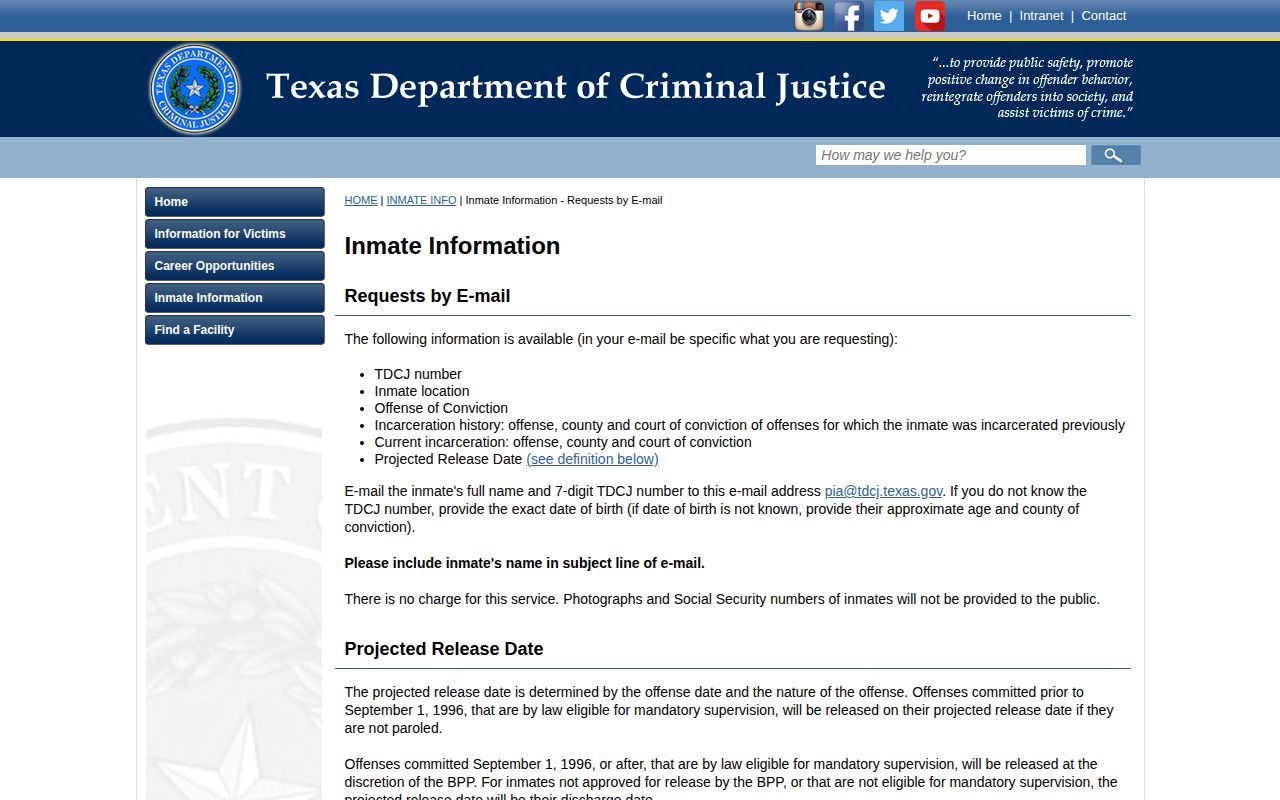
This route fills the gap left by the current-only public search. Ask for incarceration history and release or discharge information tied to the correct identifiers.
Government Code Section 552.029 makes specified TDCJ information public, including identifiers, conviction and sentence details, department photograph, and earliest or latest possible release and parole dates, subject to other law.
TDCJ Kinney Release Status
The official TDCJ telephone information page provides the current release-status routing shown here.
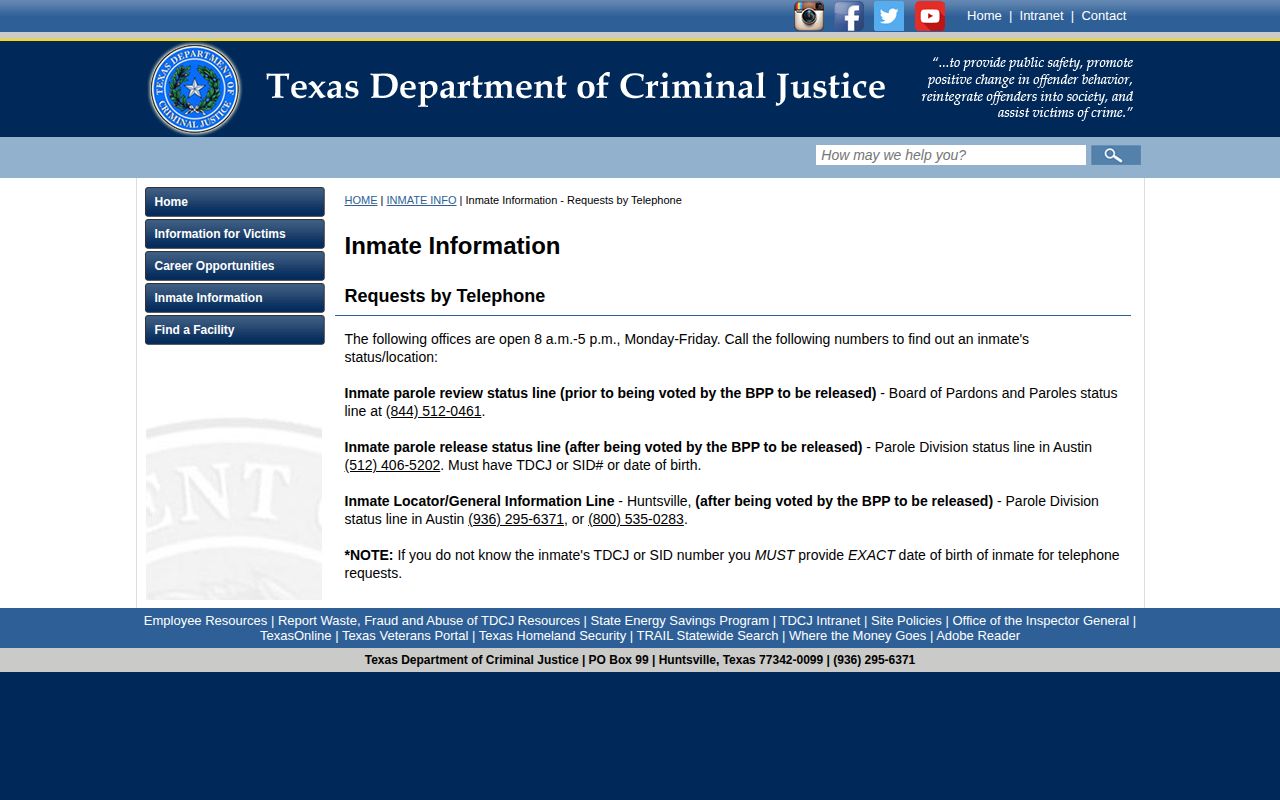
Use the TDCJ number or SID when possible. An approval vote does not prove the person crossed the release door, so confirm post-vote processing and scheduled fields with the official channel.
TDCJ Kinney Parole and IVSS
The Texas Board of Pardons and Paroles makes parole decisions. The TDCJ Parole Division supervises parole and mandatory supervision after release. These roles are separate. A person can be out of prison but not discharged from the sentence.
TDCJ’s Integrated Victim Services System, or IVSS, replaced its state-prison VINE layer in 2019. Use IVSS for TDCJ custody, parole, and mandatory-supervision notifications. County VINE remains a different path for participating local sources.
Note: A parole eligibility date begins possible review; it is not a release order or physical departure date.
TDCJ Kinney Projected Dates
Projected dates can move because of sentence credit, loss or restoration of good time, new sentences, detainers, parole decisions, calendar corrections, or court orders. The Board decides discretionary parole, not the search engine. Compare the current detail with the judgment and later agency record.
A Kinney court sentence and jail credit help explain the state calculation but do not replace TDCJ’s official time record. When a date changes, ask TDCJ for the record supporting the current field instead of calculating a promise from a prior screen.
Request TDCJ Kinney Records
Use the TDCJ records route for state-prison documents. Provide full name, TDCJ number, SID, conviction county, and a narrow record description. Ask for electronic delivery. County public-information intake cannot supply a TDCJ release record merely because the conviction began in Kinney County.
The Kinney court file remains useful for judgment, sentence, jail credit, appeal, and later court orders. Combine it with the state custody record when the exact legal and physical sequence matters.
TDCJ Kinney Release Scope
The access paths were checked in August 2026. Current search fields and contact routing can change, so use the live official pages. No TDCJ unit is claimed to exist in Kinney County.
Match identity with TDCJ number or SID, name, birth information, conviction county, offense, sentence, and unit. A name or photograph alone is weak. The department image documents state-prison identity, not a Kinney booking or present release status.
A transfer from the Kinney County Jail to TDCJ may create a short processing gap. Call the Sheriff for the county event, then use TDCJ for the receiving unit. Those records answer different parts of the chain.
Parole approval can precede release processing. Conditions, program placement, detainers, new information, and unit work may affect the actual day. Confirm through the release-status channel and unit rather than treating a vote as physical release.
After release, Parole Division and IVSS address supervision and notification. An alleged absconder or warrant status does not prove current incarceration. Confirm warrants with the issuing authority. Discharge remains distinct from release on supervision.
Federal custody is separate. A person held at KCDC under USMS authority is not a TDCJ prisoner unless the state has legal custody. BOP and ICE records cannot prove a TDCJ discharge. Classify the custodian first.
The TDCJ record and Kinney judgment should be reconciled when dates conflict. A court order supplies legal authority, while TDCJ documents state processing and physical custody. Ask each custodian to correct its own source record with exact identifiers.
For comparison with local and federal custody, use the Kinney County released inmates search. A state-prison release remains a TDCJ event even when the conviction or later residence connects to Kinney.
Verify TDCJ Kinney Discharge
Older screens must be read by label. A projected date, eligibility date, scheduled field, and completed release are not interchangeable. Save the source date and obtain the later agency record that confirms the event. TDCJ history can distinguish prior confinement from the current sentence.
Ask for the specific incarceration episode and release status. Narrow identity and date terms reduce same-name errors and help staff locate the correct record. Mandatory supervision is a statutory release form, while discretionary parole follows a Board decision. Both can place a person under Parole Division supervision.
Neither form means the sentence was fully discharged when confinement ended. A detainer may also lead from TDCJ to another custodian. Obtain the receiving agency and continue there. The TDCJ release event describes state prison custody only, so it cannot rule out a later federal, county, or immigration hold.
When a public record appears wrong, send the exact identifier and supporting judgment or order to the custodian that created it. The Kinney clerk corrects its court record, while TDCJ addresses the state custody file. Keeping those roles separate produces a more reliable release history.
Note: Confirm a former prisoner through TDCJ history and release channels because the public web search normally stops displaying the person after release.
A Kinney conviction identifies the originating case, but the statewide agency owns the prison release event and its final time record.