
Kinney Parole and Probation
A person may be free from a jail or prison and still have rules to follow. The source of those rules matters. The TDCJ Parole Division supervises people released from a Texas prison on parole or mandatory supervision. The Texas Board of Pardons and Paroles makes release decisions. Probation, formally called community supervision in Texas, comes from a court and is managed by the community supervision and corrections department named in the order.
These records should not be blended. A Kinney County judgment may place a person on community supervision without any TDCJ prison release. Conversely, a TDCJ parolee may have been convicted in Kinney County but report to a parole office elsewhere. Federal supervised release belongs to the federal court and U.S. Probation Office, not the county or TDCJ.
| Supervision | How it begins | Who controls it | Best record |
|---|---|---|---|
| Parole | Conditional release from TDCJ | Board decision; TDCJ Parole Division supervision | TDCJ status, Board action, release certificate |
| Mandatory supervision | Statutory release process when eligible | Board and TDCJ | TDCJ release fields and IVSS |
| Probation | Kinney court order | Regional CSCD and sentencing court | Judgment and supervision order |
| Federal supervised release | Federal sentence | Federal court and U.S. Probation | Federal docket and judgment |
- Parole
- Conditional release from prison before sentence discharge.
- Probation
- Court-ordered community supervision, often without a state-prison term.
- Discharge
- Formal completion of the sentence or supervision term.
- Absconder
- A person an agency alleges stopped reporting or left supervision without approval.
Verify Kinney Post-Release Supervision
Start with the record that created the supervision. Kinney County has no verified public probationer directory or sheriff absconder list. Name-only web searches are therefore weak proof. Use a TDCJ or SID number for a state case and a cause number for a court case whenever possible.
- Classify the case. Decide whether the person left Kinney County custody, TDCJ, or federal custody. A transfer is not release.
- Check the state record. For parole, review the current TDCJ detail while available and contact the Parole Division. The current inmate search is not a former-inmate archive.
- Read the court order. For probation, obtain the Kinney judgment and community-supervision order. Misdemeanors generally route through the County Clerk; felonies route through the district clerk and 63rd Judicial District.
- Confirm the office. Use the live CJAD directory or Parole Division contact route, then match the office against the written order.
- Verify completion. Request a discharge or early-termination order instead of treating a missing online entry as proof.
The broader Kinney County released-inmate search path helps classify county, state, and federal custody before a supervision inquiry begins.
Kinney Supervision Office Routing
Kinney probation is part of a regional structure. The TDCJ Community Justice Assistance Division directory groups Kinney, Terrell, and Val Verde in a regional CSCD. That department handles court-ordered community supervision. It does not supervise TDCJ parole.
Correct Agency Route
Probation or community supervision:
Regional CSCD shown in the current CJAD directory and the Kinney sentencing order
Parole or mandatory supervision:
TDCJ Parole Division
Release-status line after a Board vote: 512-406-5202
Weekdays, 8 a.m. to 5 p.m.
A Kinney case may require reporting outside the county. Confirm the live directory entry and the order before relying on an office name. Do not publish a private home address or an individual reporting schedule.
The regional arrangement also means a Brackettville address does not prove that a person reports inside Kinney County. Office assignments can follow the case, residence, or agency practice reflected in current records. Ask the department to confirm only the official office and status that it may lawfully disclose. The signed order remains the best source for the term, conditions, and court authority.
Kinney Supervision Status Changes
Conditions are the rules imposed by the court, Board, or supervising agency. They can include reporting, travel limits, program participation, and other person-specific terms. The signed order or release certificate controls. A general agency description cannot establish one person’s exact duties.
An absconder label means the agency alleges that the person failed to remain under supervision. It does not prove current jail custody. A warrant may follow, but the issuing authority must confirm whether it remains active. A motion to revoke probation, a capias, a Board warrant, and a new criminal charge are different events. Read the docket in sequence and confirm any custody event with the holding agency.
County VINELink can report changes from a participating local feed. TDCJ uses IVSS for state-prison and parole notifications. Neither service replaces the warrant, court, or discharge record.
Kinney Supervision Discharge Records
Supervision ends through the legal process that created it. A probation term may end after successful completion, and early termination requires court action where allowed. The Kinney docket may contain a discharge order. Parole or mandatory supervision ends through TDCJ sentence administration, which is distinct from release from confinement.
For written proof, ask for the precise record: the court discharge order for probation, or the TDCJ status and incarceration history for parole or sentence discharge. Texas Government Code section 552.029 identifies release and parole dates, sentence data, conviction information, and certain TDCJ fields as public categories, subject to other law. The TDCJ email information service can provide former-inmate incarceration history at no fee when supplied with adequate identifiers.
Kinney Release Property Receipts
Post-release questions often concern property, not supervision. Texas retention item PS4200-12 keeps a prisoner property inventory or receipt until release or transfer plus two years. That receipt can show what the facility recorded as returned. It does not establish parole or probation status.
Ask the originating jail custodian for the identified property receipt along with the booking-out sheet. Provide the person’s name, approximate custody dates, and booking number if known. If the source record is wrong, send the custodian the exact record identifier and any supporting court order. Correction should begin with the office that created the entry.
Note: A property receipt documents handling of listed belongings, while a discharge order documents the end of supervision.
Kinney Parole Review Records
A parole review is usually a file process, not a public courtroom-style hearing. TDCJ identifies cases before eligibility, an institutional parole officer may interview the person, and a three-member panel votes. Two votes control. An approval can include conditions, while a denial notice states the next review action.
There is no verified current day-by-day public calendar of individual Texas parole votes. The person-specific route is the Parole Review Information on a current TDCJ detail or the Board status line at 844-512-0461. Administrative Board meeting minutes are not a list of individual release hearings.
The Board’s vote-code page explains approval and denial codes. FI codes describe approval routes, RMS concerns mandatory supervision, NR sets a later review, and SA generally means serve all subject to applicable law. Approval is not proof of physical release. After a vote, confirm processing with TDCJ and the unit.
The official parole review overview shows why a decision record and a release record must be read together.
TDCJ’s parole review page is shown below as the source for the review process.
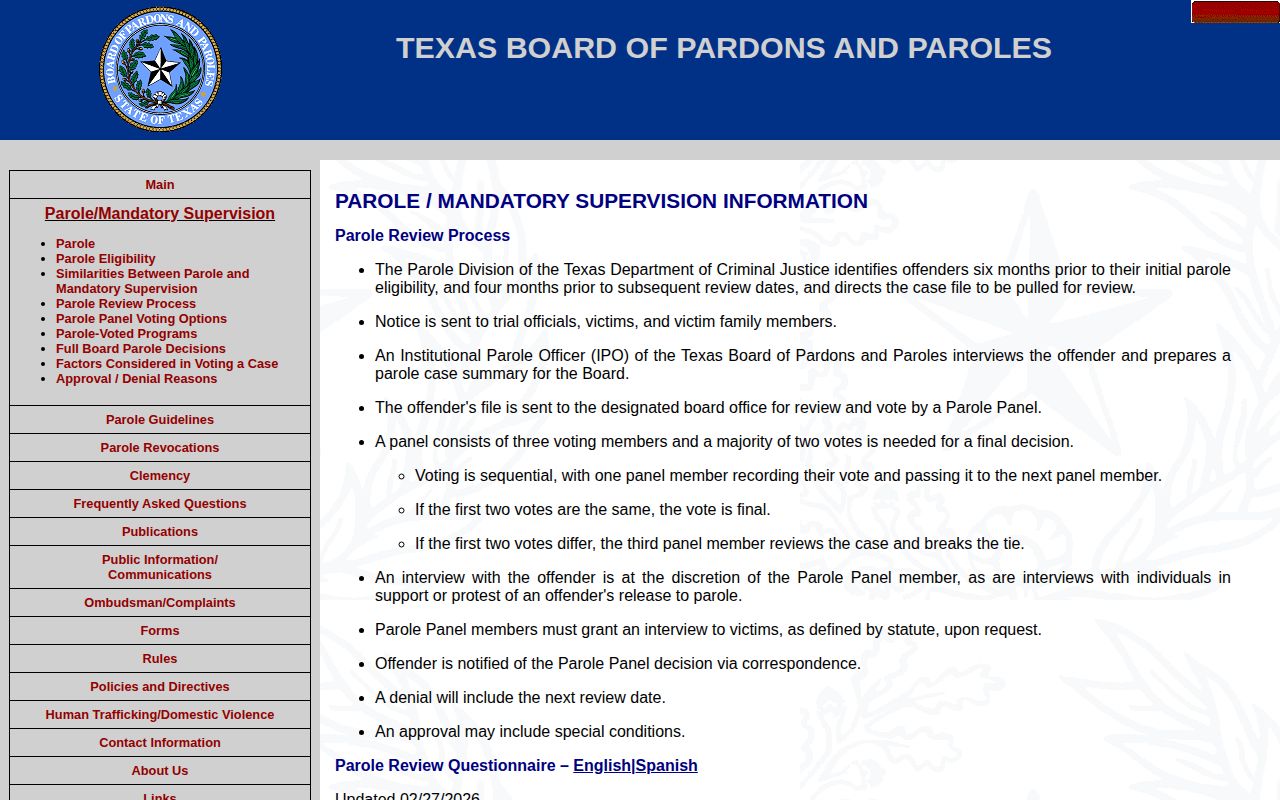
The image captures the state review source, not a Kinney County list of people on supervision.
Kinney Probation Court Records
The court record is the durable route for Kinney probation. County misdemeanor matters generally go through the County Clerk, while felony matters route through the district clerk and 63rd Judicial District. No official Kinney public name-search portal was verified. A cause number is more reliable than a name alone.
Read the chronology, not one status label. The judgment sets the sentence. A community-supervision order names the term and controlling department. Later entries can include a motion to revoke, adjudication, capias, modification, early termination, or discharge. Each has a distinct effect.
A motion or alleged violation does not by itself prove that the court revoked supervision. A capias is a court order for arrest, but current status should be verified with the issuing authority. A discharge order is stronger proof of successful completion than the absence of a directory entry.
Kinney Supervision Custody Scope
A person released from the Sheriff facility may have no supervision, county probation, or another hold. A person paroled from TDCJ is outside prison but remains on a state sentence. A federal supervisee reports under the federal judgment. These statuses cannot be inferred from one jail roster.
For TDCJ parole, use the TDCJ number or SID and the Parole Division. For probation, use the Kinney judgment and the regional CSCD named there. For federal supervised release, use the federal docket and U.S. Probation Office. If ICE custody follows a criminal case, immigration status belongs to ICE systems.
As checked August 2, 2026, Kinney County did not publish an online probationer directory or sheriff absconder list. That access gap makes direct records and agency confirmation central, not optional.